


A MOUNTAIN WITHOUT SNOW
Beaver mountain’s short season carries a statewide message
Beaver Mountain’s Early Closure Signals Bigger Water Concerns in Utah
By CAMARY NEWMAN
Apr. 25, 2026
LOGAN, Utah What should have been closing weekend at Beaver Mountain came and went quietly this year.
Instead of late-season skiers squeezing in one last run, the mountain had already been closed for more than a month after a season marked by a late opening, inconsistent snow and warm conditions that kept the snowpack from lasting the way many in Cache Valley are used to seeing.
Beaver Mountain, which says it has operated since 1939 and is the oldest continuously owned family ski resort in the United States, opened Jan. 1 this season after a lack of snow delayed the start by a couple of weeks. It also closed before it could hold its usual closing weekend events, ending a winter that locals said felt both promising and strangely short.
That early closure is about more than missed ski days. It also points to a bigger story playing out across Utah: warmer winters, shrinking snowpack and changing water conditions that affect ski resorts, local communities and the state’s long-term water supply.
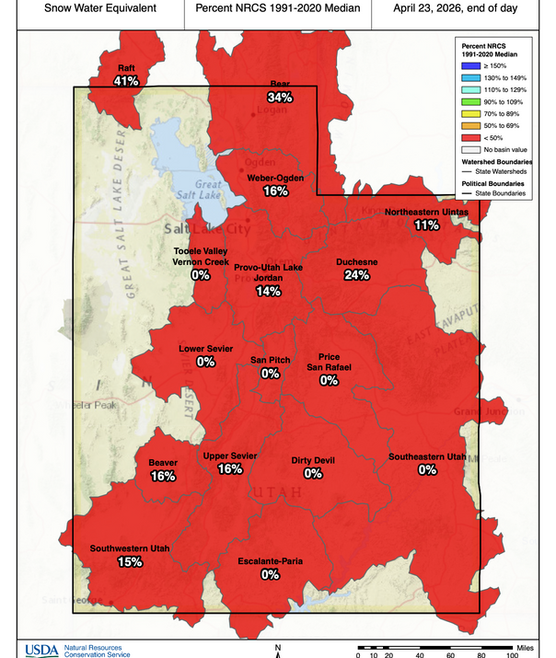
According to the Utah Division of Water Resources, about 95% of Utah’s water supply comes from snowpack. State officials have said this year’s snowpack was the lowest on record and peaked three weeks early, reaching just 8.4 inches on March 9, about half of what Utah typically receives by early April. In the Bear River Basin, which includes the mountains above Cache Valley, NOAA’s Colorado Basin River Forecast Center reported model snow at just 33% of normal on April 6 and forecast April through July runoff at 56 kaf, or 51% of average.
Patrick Belmont, a professor in Utah State University’s Department of Watershed Sciences, said the snowpack this year was “terrible” and, on the scale of the Great Salt Lake watershed, was about “a quarter of a normal year.” He said Utah ended up closer to normal in total precipitation than many people realize, but much of that came as rain instead of snow.
That difference matters, Belmont said, because rain does not stay in the system the same way snow does. “The rain will evaporate more readily,” he said. “It doesn’t stay as long into the late spring and sometimes even early summer.”
Belmont said warmer conditions were a major part of the problem this winter, and he pointed to a slowing, more meandering jet stream as one reason weather patterns have looked so unusual. He said that instability can leave Utah warmer and drier while other parts of the country see colder, snowier winters.
At Beaver Mountain, those bigger weather patterns showed up in practical and sometimes dangerous ways. Matt Logan, who works in social media and ski patrol at the resort, said the season depended on a few major storms and never developed the kind of lasting base Beaver normally relies on.
“The biggest reason was just the lack of consistent snow,” Logan said. “We had a few big storms that really carried the season for us, but overall we never built the kind of base we normally like to have.”
Logan said the warm temperatures were especially unusual. He said longtime Beaver employee Travis Seals told him he had never seen 60-degree weather on the mountain while the resort was still open, something Logan described as “definitely unusual.”
From the ski patrol side, Logan said the poor snow conditions changed the mountain in ways guests may not always notice. During a long stretch with little fresh snowfall, he said there was less powder and more hard, fast skiing, which led to more speed-related injuries.
“The conditions of the snow made ski patrolling very different,” Logan said. “We saw a lot more speed-related injuries, where people would collided with each other or with a tree, for example.”
Logan said the season also brought a first in Beaver’s history: a life flight before 9:30 a.m. He said the incident underscored how serious conditions could become.
As spring temperatures rose, he said conditions became too thin and unstable to keep operating safely. Mud, dirt and rocks began showing through, and without an easy way down the mountain, beginner and intermediate skiers were left with fewer safe options.
Even so, Logan said the mood on the mountain stayed surprisingly positive. “Guests were overall still in good spirits,” he said. “We have a great community up here that is always happy just to have the chance to ski the Beav. It felt like everyone really took advantage of the snow we did get.”
That same support carried through Beaver’s first season with its new ski lodge, which includes the rental shop, ticket office and food court. Logan said the lodge was “a big hit with the community,” even if the resort did not get the kind of winter everyone had hoped would introduce it.
For lifelong Logan resident Erin Henning, the season felt strange precisely because it included both some great ski days and a disappointing ending.
Henning said she has lived in Logan her whole life and now shares her love of “skiing the Beave” with her children. She said Beaver has always felt different from larger destination resorts because of its atmosphere and sense of community. “There’s something amazing about Beaver,” Henning said. “It doesn’t have that busy resort feel. Yeah, the lifts might be slower, but the mountain and the atmosphere have always been so welcoming.”
Henning said that contrast is what made this year so odd. “It’s such a weird season because, on one hand, we had some really good snowfall, but at the same time we had a late opening and an early closing,” she said.
Belmont said that is why a bad snow year cannot be viewed as just a ski story. He said low snowpack carries into reservoirs, rivers and the Great Salt Lake, which remains one of Utah’s most visible water warnings. He said reservoirs across the state are likely to be low this year and called the lake especially concerning. “Great Salt Lake is really concerning to me,” Belmont said. “It’s very possible that Great Salt Lake will reach another historic low.”
That concern goes well beyond the shoreline. Utah water officials say shrinking lake levels have exposed more than 800 square miles of lakebed, creating dust hotspots that can send polluted dust into nearby communities. More than 2.66 million residents live downwind, and the dust can worsen air quality while exposing people to pollutants including arsenic.
Belmont argued that part of the problem is structural, not just seasonal. He said Utah has issued more water rights than there is actual water to support. “We’ve got way more water rights issued than we have actual water,” Belmont said.
That tension is playing out as Utah leaders push to restore the lake by 2034. Gov. Spencer Cox closed the Great Salt Lake Basin to new water right appropriations in 2022, and in September 2025 state leaders signed the Great Salt Lake 2034 Charter, setting healthier lake levels as a target before the Winter Olympics return to Utah.
Belmont said years like this are the kind scientists have expected to see more often. He said research he did on Utah ski resorts years ago pointed toward more seasons like this one, and that resorts across the state “really took it on the chin this year.” He added that many are trying to diversify with summer activities, but that mountain biking, events and festivals are not the same as a ski season and do not bring the same flow of people.
That is what makes Beaver Mountain’s early closure feel bigger than one off year at one ski resort. For skiers and families, it meant a shorter season. For Beaver staff, it meant the loss of expected weeks of work and the cancellation of a closing weekend tradition. For people in Cache Valley, it was another sign that winter does not always look the way it used to or that we want it to.
Across Utah, the larger concern is not just one short ski season, but what happens when winters arrive later, leave earlier and leave behind less water for everything that depends on it.
By CAMARY NEWMAN


Photos by CAMARY NEWMAN